Maia · 62 · Returning to dancing
Left knee replacementSurgical history, made visible
Cardiac deviceContext that follows her care
Right shoulder reach · 124°112° at the previous visit
Tingling · both feetWhere she reports feeling it
Index 03 / Movement

Real-time anatomy · iOS and web

Teaching a bodyto explain itself.

People can’t feel what they can’t see. An exercise list says what to do; this shows why. I designed the renderer’s layers, its motion and camera language, and the clinical rules every movement follows. Everything below is the production renderer, running live in your browser.

RoleDesign, motion, clinical direction
MediumThree.js on web, native on iOS
Library295 movements, two bodies
Scroll
01 / 05 · Muscles

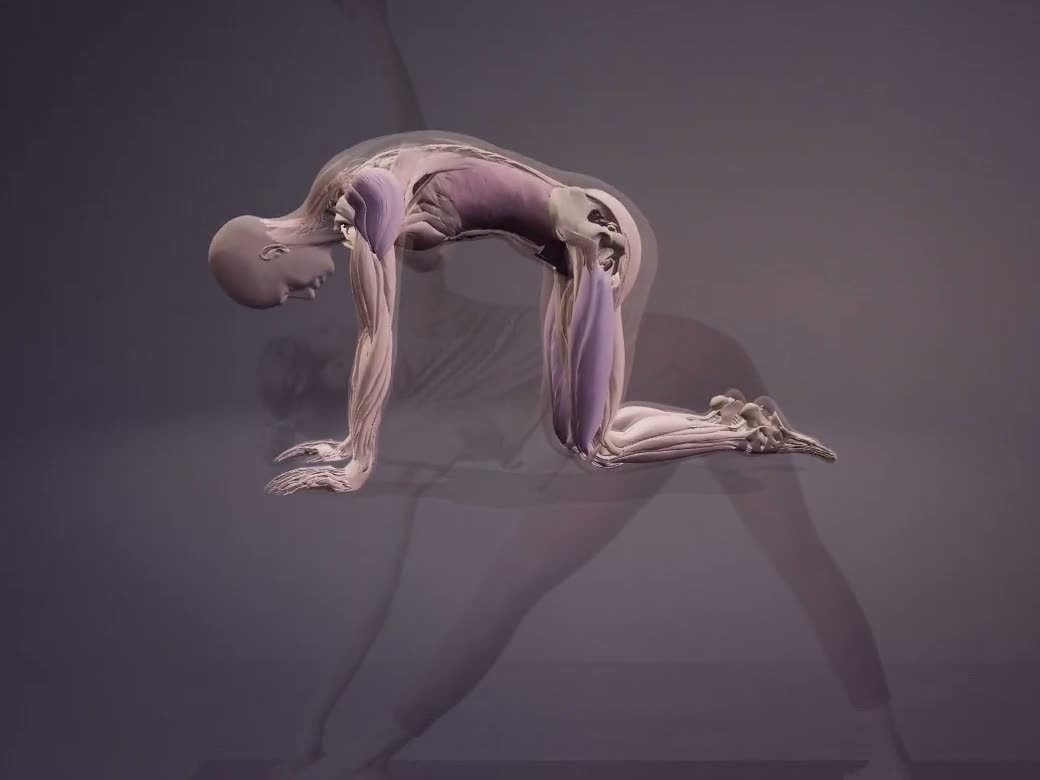
The work shifts between muscles.

Why
A pose tells someone where to be. Care is about what is working, and in a cat cow the effort moves: the abdominals lead into the round, the spinal extensors into the release.
How
Every muscle follows its own curve through the cycle, written to a small shader table each frame. Working regions take a deeper rose; the muscles around them stay muted and opaque, so emphasis reads without the whole body glowing.
Watch the phase readout below the body: it is the clip’s own clock.
02 / 05 · Deep

Look beneath the surface.

Why
After childbirth, the deep abdominal wall helps support and control the spine. You can’t cue someone to use a muscle they can’t picture.
How
A dissection, not an x-ray. The deep muscle at work is solid and lit, the muscles over it turn to faint glass, resting layers clear, and the rest of the body becomes one pane. Then the camera rises over the spine to show the erectors controlling extension as the movement turns.
The view explains anatomy. It never diagnoses a separation or promises to close one.
03 / 05 · Systems

Breath is part of the movement.

Why
The diaphragm helps us breathe and contributes to postural control, so breathing belongs in the picture of trunk work. Working muscle opens its vessels, and the heart answers.
How
Breath follows the movement, as it is taught: exhale as the spine rounds and the deep abdominals draw in, inhale as it releases. With each inhale the ribs widen, the diaphragm descends and the lungs fill, within physiologic distances. The heart and vessels keep their own clock.
Adjacent evidence: Hodges and Gandevia, 2000
04 / 05 · Nerves

Control is a nervous-system skill.

Why
Opposite arm, opposite leg, a steady reach. Coordination is what a bird dog trains. Showing the pathway turns “control” from a word into something you can watch.
How
Each working nerve is one continuous line from the motor strip, down the cord, out to the muscle. A brighter bead travels from brain to muscle as the muscle switches on. It replaced a dotted line that read as a diagram instead of a signal.
Roots in plain language: the inferior gluteal nerve, L5 to S2, drives the glutes.
05 / 05 · Load

Strength, dosed.

Why
Mobility is an entry point, not a substitute for progressive resistance. During GLP-1 care, strength matters alongside weight.
How
The prescription speaks in effort a person can feel, and it rides beside the body that is lifting it. On the way down the glutes and hamstrings lengthen under load; on the way up they drive.
Illustrative dose. A real prescription answers to the person’s record and feedback.

Phased contraction

Muscles don’t switch on.They phase.

A blanket highlight on “the glutes” teaches the wrong thing. Muscles lengthen under control on the way down, drive on the way up, and hand work to each other through a cycle. Every movement carries a curve for each muscle and a role for each phase, and the phases come from the motion itself.

Curves and phase boundaries from the production motion library.

Cat cow, one cycle

Emphasis weight by muscle, 0 to 1, across the clip’s own phases

Hip hinge with dumbbells

Glutes and hamstrings, role by phase

On the way down they lengthen under load. On the way up they drive.

Lengthening under controlDriving

Widths are the clip’s real phase lengths. The head sweeps at the movement’s own tempo.

Across the library

Every muscle track, by the role it plays

One person, made visible

Meet Maia. 62, returning to dancing.

An illustrative patient after breast cancer treatment and a knee replacement. Her records, photos and movement videos gather around the body they describe.

Concept in development. A fictional patient.
Records become a body

The chart, in the shape of a person.

Records fan out, turn as one wheel, then file into the avatar one at a time, so the viewer sees each source land. On a phone, fewer details per card; eight miniature records are not legible.

AI pose and vision models connecting video and photos to clinical records are in development.
History that follows care

A knee replacement. A cardiac device.

Her history changes how strength is rebuilt after treatment. The camera approaches each finding as it is named, holds long enough to read, then moves on.

Progress you can see

Shoulder reach, 112° to 124°.

Measured progress toward dressing comfortably and reaching a shelf again. A number with a meaning, pinned to the arm it describes.

What she feels

Tingling in both feet. Steadier steps first.

Reported sensation is placed where she feels it, and it reshapes the plan: dancing starts with balance. The scene ends on the whole person, not on a body part.

Motion craft

The details nobody namesand everybody feels.

  • Holds are intentional

    Approach, let the viewer read, then move. Easing brings velocity and acceleration to rest at every hold.

  • The camera follows the story

    Shots are bound to the story’s beats, never to a timer, so revising the words can’t leave the camera on the wrong view.

  • One continuous path

    The camera eases toward each composed shot with gentle starts and stops. On this page, scroll is the clock.

  • The whole cycle stays in frame

    Containment holds at every angle. On a phone, the view keeps a readable three-quarter angle.

  • Coupled joints share one curve

    Joints that move together ease together, with overlapping stages instead of segmented handoffs.

  • Contact is honest

    Palms stay planted, a hand on the wall rests on its ulnar edge, and props keep clearance from the body.

  • Stretch-only highlights

    In a stretch, only the tissue being lengthened lights. Everything else rests at its own tone.

  • Nothing is unanimatable

    If a movement is clinically real, the library finds a way to show it.

Anatomy adapted from Z-Anatomy and BodyParts3D, CC BY-SA 4.0. Credits

Daniel J. Green, PT, DPTLive production renderer. Fictional people; illustrative weights, not measured activation.