Pregnancy · Postpartum · Cycle health
Care for
a changing body.
A woman’s context changes the care she needs. I designed and built a digital experience that carries that context from her everyday life into the clinician’s decisions.
Explore the experience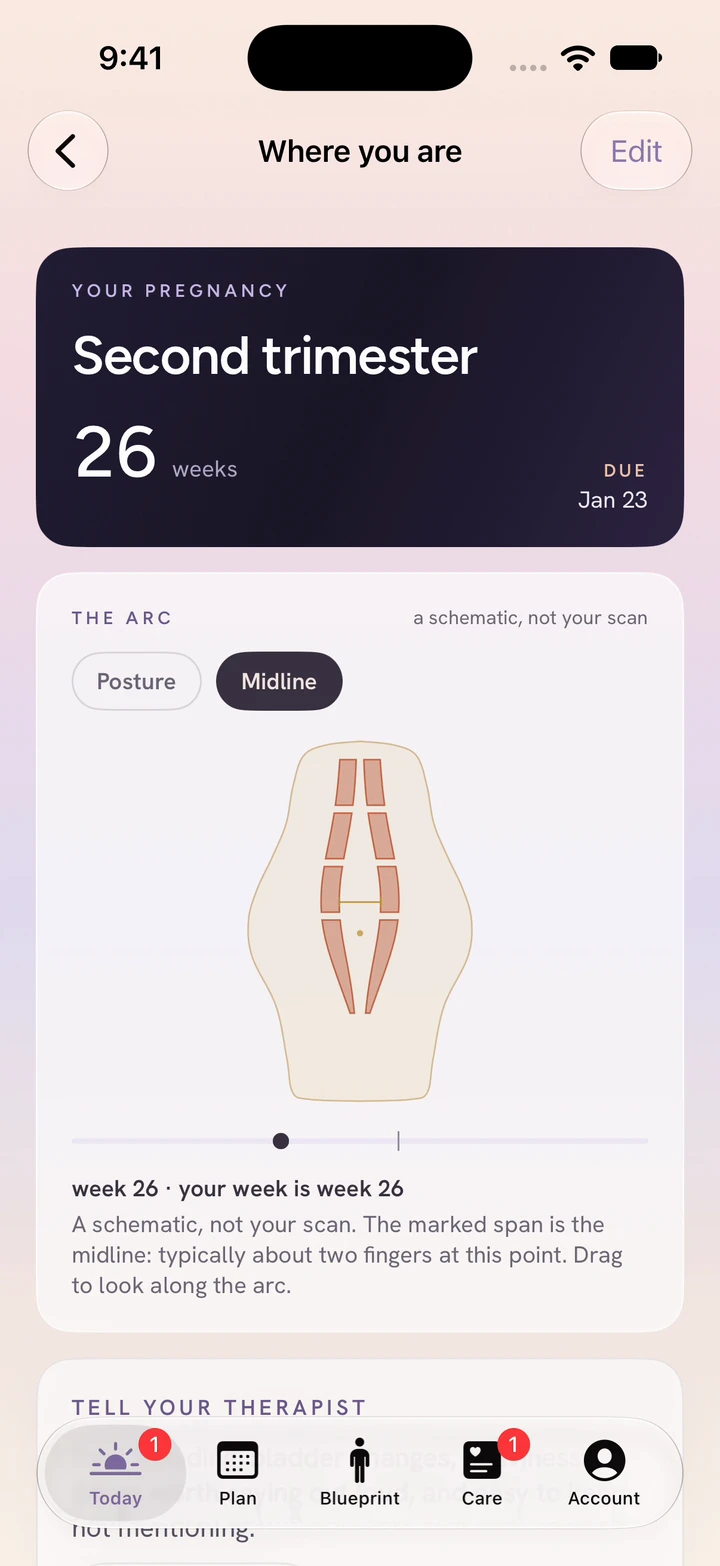
Why I started
Care, from 300 miles away.
When my sister had a difficult pregnancy, we lived more than 300 miles apart. Creating digital experiences became one way to support her daily health choices. That experience still shapes my product work: useful care has to meet someone in the life she is actually living.
01 / Make the context visible
A life stage should
shape the experience.
Pregnancy, postpartum recovery, and cycle health each change what someone wants to understand. I connected life stage, delivery history, and pelvic-health context to movement planning and the way the product explains the body.
Explore change. Return to now.
Drag through the pregnancy and postpartum anatomy arc, then return to your own week. The interaction makes change explorable while keeping the current stage as the reference point.
A history she can bring into care.
Cycle starts and symptom check-ins become a history the member can understand and share. The app, clinician view, and downloadable report use the same underlying information.
Recordings from the implemented iOS experience, using synthetic demo data. Anatomy is presented as a schematic.
02 / Connect understanding to care
One context.
Two useful views.
The member needs a clear explanation. The clinician needs the history and reasoning behind it. Explore how I organize the same context for each person.
Shared context
Pregnancy, week 26
A member wants to stay active while understanding changes in her body.
- Life stage
- 26 weeks pregnant
- Member check-in
- Pelvic discomfort after a longer walk
- Apple Health
- Sleep below her recent personal baseline
What she sees
Your week, in context.
Your sleep is lower than your recent usual. You also noted discomfort after walking. Your therapist can see both alongside your pregnancy stage when reviewing your plan.
Keep the symptom check-in with the week it happened, so there is less to reconstruct at the next visit.
03 / The product decisions
What makes this
more than tracking.
Care changes after birth.
Pregnancy and postpartum use distinct care pathways. Delivery history and pelvic-health context remain part of the profile, so a change in life stage carries through to movement planning.
The decision: model the transition in the care experience itself.
Explain a signal in her context.
Apple Health sleep, activity, and cardiovascular signals are compared with the member’s own recent baseline. That context informs movement intensity and the explanation she sees, alongside symptoms and clinician review.
The decision: carry the reasoning into both member and clinician views.
Make the history portable.
Cycle history and symptom patterns feed a shared report model. The member can bring the same information she sees in the app into a conversation with her clinician.
The decision: build the handoff as part of the product.
My contribution
From clinical question
to working experience.
I own product direction, requirements, experience design, and implementation. The work spans native iOS interfaces, a shared web engine, Apple Health integration, and the clinician workflow that supports the member.
- Understand
- Life stage, goals, symptoms, delivery history, and the questions that arise between visits.
- Build
- Pregnancy and postpartum pathways, interactive anatomy, cycle history, reports, and personal-baseline health context.
- Evaluate
- Scenario-based checks for personalization and clinical relevance, source-to-claim checks, and clinician confirmation of clinical drafts.
02 / Next
Member app
Explore the wider care experience